
| 일 | 월 | 화 | 수 | 목 | 금 | 토 |
|---|---|---|---|---|---|---|
| 1 | 2 | 3 | 4 | 5 | 6 | 7 |
| 8 | 9 | 10 | 11 | 12 | 13 | 14 |
| 15 | 16 | 17 | 18 | 19 | 20 | 21 |
| 22 | 23 | 24 | 25 | 26 | 27 | 28 |
- 싱글톤
- orelse
- junit5
- mokito
- topic
- Stream
- 함수형 프로그래밍
- TDD
- #패스트캠퍼스 #환급챌린지 #패스트캠퍼스후기 #습관형성 #직장인자기계발 #오공완
- optional
- 인텔리제이 단축키
- Functional Programming
- 디자인패턴
- orElseGet
- signWith
- 카프카
- JWT
- Factory Method Pattern
- effective java
- Java8
- Authentication
- Spring Security
- git cli
- 패스트캠퍼스 #환급챌린지 #패스트캠퍼스후기 #습관형성 #직장인자기계발 #오공완
- kafka
- Java
- Clean Code
- producer
- SpringBoot
- consumer
- Today
- Total
goodbye
패스트캠퍼스 환급챌린지 49일차 : 테디노트의 RAG 비법노트 강의 후기 본문
본 포스팅은 패스트캠퍼스 환급 챌린지 참여를 위해 작성하였습니다
https://fastcampus.info/4n8ztzq
(~6/20) 50일의 기적 AI 환급반💫 | 패스트캠퍼스
초간단 미션! 하루 20분 공부하고 수강료 전액 환급에 AI 스킬 장착까지!
fastcampus.co.kr
패스트캠퍼스 환급챌린지 49일차!
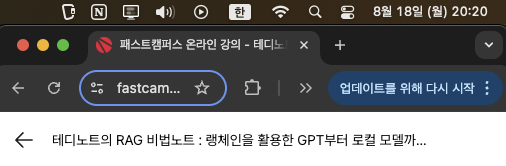
1) 공부 시작 시간 인증
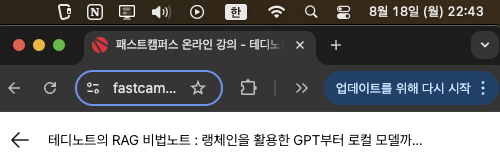
2) 공부 종료 시간 인증
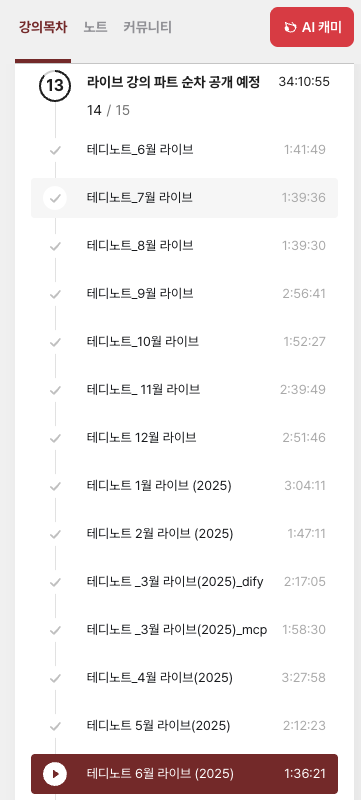
3) 강의 수강 클립 인증
4) 학습 인증샷

5) 학습통계

Today I Learned
다양한 상태 스키마
더 복잡한 시스템의 경우, 부모 그래프와 완전히 다른 스키마 (공유 키 없음) 를 갖는 하위 그래프를 정의할 수 있습니다 .
예를 들어, 다중 에이전트 시스템 에서 각 에이전트의 개인 메시지 기록을 보관할 수 있습니다 .애플리케이션에서 이러한 상황이 발생한다면, 하위 그래프를 호출하는 노드 함수를 정의해야 합니다. 이 함수는 하위 그래프를 호출하기 전에 입력(부모) 상태를 하위 그래프 상태로 변환하고, 노드에서 상태 업데이트를 반환하기 전에 결과를 부모 상태로 다시 변환해야 합니다.
from typing_extensions import TypedDict
from langgraph.graph.state import StateGraph, START

class SubgraphState(TypedDict):
    bar: str

# Subgraph

def subgraph_node_1(state: SubgraphState):
    return {"bar": "hi! " + state["bar"]}

subgraph_builder = StateGraph(SubgraphState)
subgraph_builder.add_node(subgraph_node_1)
subgraph_builder.add_edge(START, "subgraph_node_1")
subgraph = subgraph_builder.compile()

# Parent graph

class State(TypedDict):
    foo: str

def call_subgraph(state: State):
    subgraph_output = subgraph.invoke({"bar": state["foo"]})
    return {"foo": subgraph_output["bar"]}

builder = StateGraph(State)
builder.add_node("node_1", call_subgraph)
builder.add_edge(START, "node_1")
graph = builder.compile()
다양한 상태 스키마 예
from typing_extensions import TypedDict
from langgraph.graph.state import StateGraph, START

# Define subgraph
class SubgraphState(TypedDict):
    # note that none of these keys are shared with the parent graph state
    bar: str
    baz: str

def subgraph_node_1(state: SubgraphState):
    return {"baz": "baz"}

def subgraph_node_2(state: SubgraphState):
    return {"bar": state["bar"] + state["baz"]}

subgraph_builder = StateGraph(SubgraphState)
subgraph_builder.add_node(subgraph_node_1)
subgraph_builder.add_node(subgraph_node_2)
subgraph_builder.add_edge(START, "subgraph_node_1")
subgraph_builder.add_edge("subgraph_node_1", "subgraph_node_2")
subgraph = subgraph_builder.compile()

# Define parent graph
class ParentState(TypedDict):
    foo: str

def node_1(state: ParentState):
    return {"foo": "hi! " + state["foo"]}

def node_2(state: ParentState):
    response = subgraph.invoke({"bar": state["foo"]})
    return {"foo": response["bar"]}

builder = StateGraph(ParentState)
builder.add_node("node_1", node_1)
builder.add_node("node_2", node_2)
builder.add_edge(START, "node_1")
builder.add_edge("node_1", "node_2")
graph = builder.compile()

for chunk in graph.stream({"foo": "foo"}, subgraphs=True):
    print(chunk)

((), {'node_1': {'foo': 'hi! foo'}})
(('node_2:9c36dd0f-151a-cb42-cbad-fa2f851f9ab7',), {'grandchild_1': {'my_grandchild_key': 'hi Bob, how are you'}})
(('node_2:9c36dd0f-151a-cb42-cbad-fa2f851f9ab7',), {'grandchild_2': {'bar': 'hi! foobaz'}})
((), {'node_2': {'foo': 'hi! foobaz'}})
다양한 상태 스키마(두 레벨의 하위 그래프)
# 부모 -> 자식 -> 손자라는 두 수준의 하위 그래프가 있는 예입니다.

# Grandchild graph
from typing_extensions import TypedDict
from langgraph.graph.state import StateGraph, START, END

class GrandChildState(TypedDict):
    my_grandchild_key: str

def grandchild_1(state: GrandChildState) -> GrandChildState:
    # NOTE: child or parent keys will not be accessible here
    return {"my_grandchild_key": state["my_grandchild_key"] + ", how are you"}

grandchild = StateGraph(GrandChildState)
grandchild.add_node("grandchild_1", grandchild_1)

grandchild.add_edge(START, "grandchild_1")
grandchild.add_edge("grandchild_1", END)

grandchild_graph = grandchild.compile()

# Child graph
class ChildState(TypedDict):
    my_child_key: str

def call_grandchild_graph(state: ChildState) -> ChildState:
    # NOTE: parent or grandchild keys won't be accessible here
    grandchild_graph_input = {"my_grandchild_key": state["my_child_key"]}
    grandchild_graph_output = grandchild_graph.invoke(grandchild_graph_input)
    return {"my_child_key": grandchild_graph_output["my_grandchild_key"] + " today?"}

child = StateGraph(ChildState)
child.add_node("child_1", call_grandchild_graph)
child.add_edge(START, "child_1")
child.add_edge("child_1", END)
child_graph = child.compile()

# Parent graph
class ParentState(TypedDict):
    my_key: str

def parent_1(state: ParentState) -> ParentState:
    # NOTE: child or grandchild keys won't be accessible here
    return {"my_key": "hi " + state["my_key"]}

def parent_2(state: ParentState) -> ParentState:
    return {"my_key": state["my_key"] + " bye!"}

def call_child_graph(state: ParentState) -> ParentState:
    child_graph_input = {"my_child_key": state["my_key"]}
    child_graph_output = child_graph.invoke(child_graph_input)
    return {"my_key": child_graph_output["my_child_key"]}

parent = StateGraph(ParentState)
parent.add_node("parent_1", parent_1)
parent.add_node("child", call_child_graph)
parent.add_node("parent_2", parent_2)

parent.add_edge(START, "parent_1")
parent.add_edge("parent_1", "child")
parent.add_edge("child", "parent_2")
parent.add_edge("parent_2", END)

parent_graph = parent.compile()

for chunk in parent_graph.stream({"my_key": "Bob"}, subgraphs=True):
    print(chunk)

((), {'parent_1': {'my_key': 'hi Bob'}})
(('child:2e26e9ce-602f-862c-aa66-1ea5a4655e3b', 'child_1:781bb3b1-3971-84ce-810b-acf819a03f9c'), {'grandchild_1': {'my_grandchild_key': 'hi Bob, how are you'}})
(('child:2e26e9ce-602f-862c-aa66-1ea5a4655e3b',), {'child_1': {'my_child_key': 'hi Bob, how are you today?'}})
((), {'child': {'my_key': 'hi Bob, how are you today?'}})
((), {'parent_2': {'my_key': 'hi Bob, how are you today? bye!'}})
지속성 추가
부모 그래프를 컴파일할 때만 체크포인터를 제공 하면 됩니다 . LangGraph가 자동으로 체크포인터를 자식 하위 그래프에 전파합니다.
from langgraph.graph import START, StateGraph
from langgraph.checkpoint.memory import MemorySaver
from typing_extensions import TypedDict

class State(TypedDict):
    foo: str

# Subgraph

def subgraph_node_1(state: State):
    return {"foo": state["foo"] + "bar"}

subgraph_builder = StateGraph(State)
subgraph_builder.add_node(subgraph_node_1)
subgraph_builder.add_edge(START, "subgraph_node_1")
subgraph = subgraph_builder.compile()

# Parent graph

builder = StateGraph(State)
builder.add_node("node_1", subgraph)
builder.add_edge(START, "node_1")

checkpointer = MemorySaver()
graph = builder.compile(checkpointer=checkpointer)
``
하위 그래프가 자체 메모리를 갖도록 하려면 적절한 체크포인터 옵션을 사용하여 컴파일할 수 있습니다. 이는 다중 에이전트 시스템에서 에이전트가 내부 메시지 기록을 추적하도록 하려는 경우 유용합니다.
subgraph_builder = StateGraph(...)
subgraph = subgraph_builder.compile(checkpointer=True)
하위 그래프 상태 보기
지속성을 활성화하면 적절한 메서드를 통해 그래프 상태(체크포인트)를 검사 할 수 있습니다 . 하위 그래프 상태를 보려면 subgraphs 옵션을 사용할 수 있습니다.
그래프 상태는 를 통해 검사할 수 있습니다 graph.get_state(config). 하위 그래프 상태를 보려면 를 사용할 수 있습니다 graph.get_state(config, subgraphs=True).
중단 시에만 사용 가능
하위 그래프 상태는 하위 그래프가 중단된 경우 에만 볼 수 있습니다 . 그래프를 다시 시작하면 하위 그래프 상태에 액세스할 수 없습니다.
중단된 하위 그래프 상태 보기
from langgraph.graph import START, StateGraph
from langgraph.checkpoint.memory import MemorySaver
from langgraph.types import interrupt, Command
from typing_extensions import TypedDict

class State(TypedDict):
    foo: str

# Subgraph

def subgraph_node_1(state: State):
    value = interrupt("Provide value:")
    return {"foo": state["foo"] + value}

subgraph_builder = StateGraph(State)
subgraph_builder.add_node(subgraph_node_1)
subgraph_builder.add_edge(START, "subgraph_node_1")

subgraph = subgraph_builder.compile()

# Parent graph

builder = StateGraph(State)
builder.add_node("node_1", subgraph)
builder.add_edge(START, "node_1")

checkpointer = MemorySaver()
graph = builder.compile(checkpointer=checkpointer)

config = {"configurable": {"thread_id": "1"}}

graph.invoke({"foo": ""}, config)
parent_state = graph.get_state(config)
subgraph_state = graph.get_state(config, subgraphs=True).tasks[0].state

# resume the subgraph
graph.invoke(Command(resume="bar"), config)
스트림 서브그래프 출력
스트리밍 출력에 하위 그래프의 출력을 포함하려면 부모 그래프의 stream 메서드에서 subgraphs 옵션을 설정하면 됩니다. 이렇게 하면 부모 그래프와 모든 하위 그래프의 출력이 모두 스트리밍됩니다.
for chunk in graph.stream(
    {"foo": "foo"},
    subgraphs=True,
    stream_mode="updates",
):
    print(chunk)
하위 그래프에서 스트리밍
# 하위 그래프에서 스트리밍
from typing_extensions import TypedDict
from langgraph.graph.state import StateGraph, START

# Define subgraph
class SubgraphState(TypedDict):
    foo: str
    bar: str

def subgraph_node_1(state: SubgraphState):
    return {"bar": "bar"}

def subgraph_node_2(state: SubgraphState):
    # note that this node is using a state key ('bar') that is only available in the subgraph
    # and is sending update on the shared state key ('foo')
    return {"foo": state["foo"] + state["bar"]}

subgraph_builder = StateGraph(SubgraphState)
subgraph_builder.add_node(subgraph_node_1)
subgraph_builder.add_node(subgraph_node_2)
subgraph_builder.add_edge(START, "subgraph_node_1")
subgraph_builder.add_edge("subgraph_node_1", "subgraph_node_2")
subgraph = subgraph_builder.compile()

# Define parent graph
class ParentState(TypedDict):
    foo: str

def node_1(state: ParentState):
    return {"foo": "hi! " + state["foo"]}

builder = StateGraph(ParentState)
builder.add_node("node_1", node_1)
builder.add_node("node_2", subgraph)
builder.add_edge(START, "node_1")
builder.add_edge("node_1", "node_2")
graph = builder.compile()

for chunk in graph.stream(
    {"foo": "foo"},
    stream_mode="updates",
    subgraphs=True,
):
    print(chunk)

((), {'node_1': {'foo': 'hi! foo'}})
(('node_2:e58e5673-a661-ebb0-70d4-e298a7fc28b7',), {'subgraph_node_1': {'bar': 'bar'}})
(('node_2:e58e5673-a661-ebb0-70d4-e298a7fc28b7',), {'subgraph_node_2': {'foo': 'hi! foobar'}})
((), {'node_2': {'foo': 'hi! foobar'}})